Dec. 28, 05.
On this day first I headed to Toyota’s Commemorative Museum of Industry and Technology. I have to say it’s the best science/engineering museum that I have ever visited.
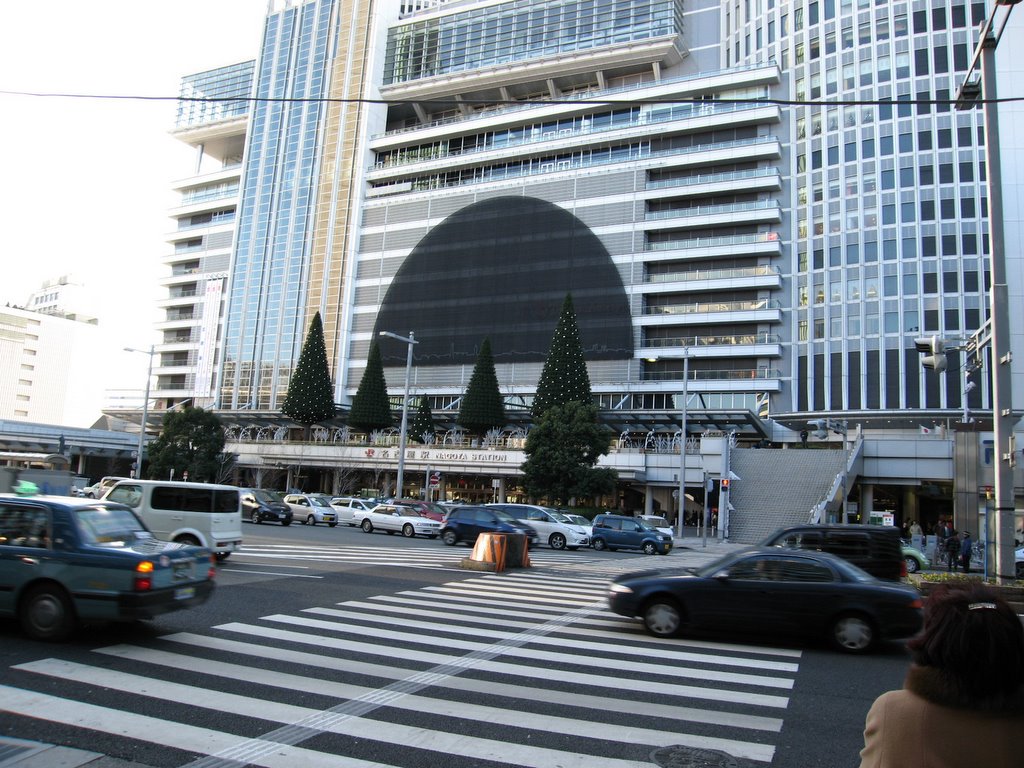
The museum shows how Toyota started out as a maker of automatic looms of fabrics into the No. 2 (and soon to be No. 1) automaker in the world. When I went there at the opening time of 9 am, I was probably the 4th or 5th person to go there.
The museum is split into 2 sections, one section is all about automatic looms and fabrics, and the other part is all about automobiles.
The section on the looms was pretty amazing because not only did they have lots of historical automatic looms that were used before, but they all still work and they had people who would demonstrate them. It was so amazing seeing all that “ancient” machinery still working with all those gears and belts.
Winter Trip: Day 5 of 5 Nagoya, Toyota Commemorative Museum of Industry and Technology and Toyota Automotive Museum and “Linimo” Maglev Train


Kyoto - Nintendo, Kiyomizu Temple, Gion
(Updated: October 7, 2007 with Google Map; June 4, 2013 with high resolution photos and new descriptions)
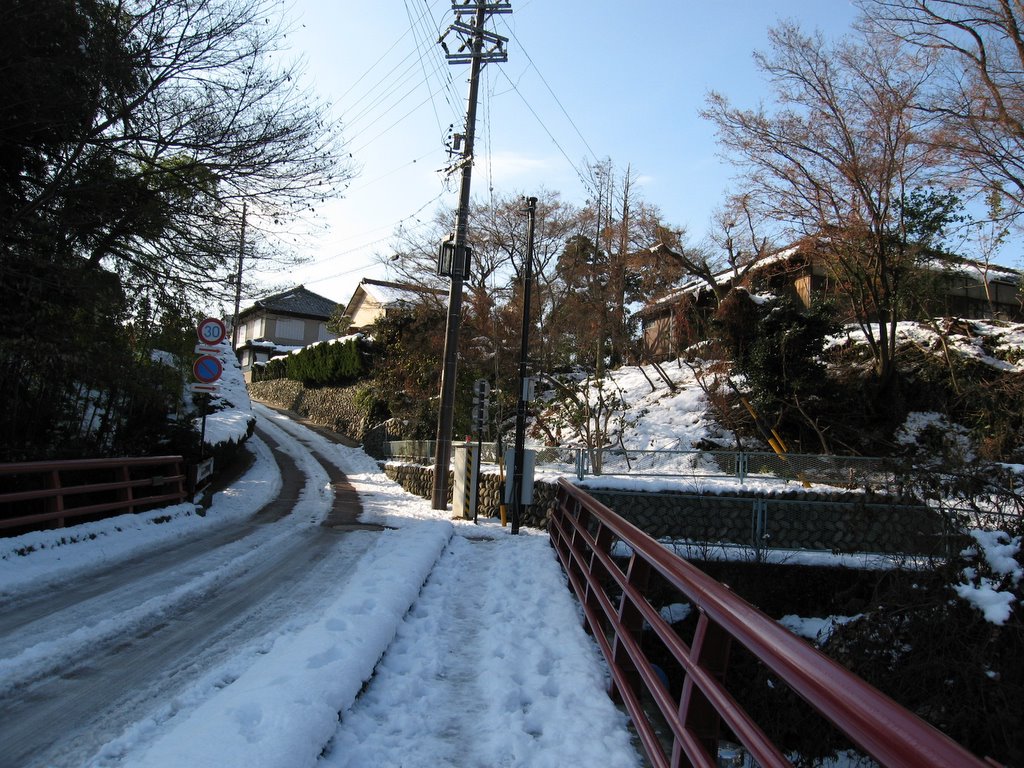
On December 27, 2005, I went to Kyoto from Nagoya. Going to Kyoto took about 2 hours by local train, it involved going up a mountain pass. When it was going up the mountain pass, it was snowing hard so it looked really nice. I had to transfer trains at some station in the mountainous area. At the station there was a lot of snow and fresh snow too.
I arrived at Kyoto at around 9 am or 10 am, and I only had 2 places that I wanted to visit, the Nijo Castle (二条城) and the Kiyomizu Temple (清水寺). I wanted to visit these 2 places because the first time I came here in 2004 I had already seen to other stuff. Once again, the Nijo Castle was closed, last year when my family and I came to Kyoto, we went to Nijo Castle late and it was closed and we came back on another day after doing sightseeing elsewhere and we were late and it was closed so this is the 3rd time I came and it was closed. The Kiyomizu Temple was open but since I had all day I wanted to “visit” Nintendo headquarters. I asked the tourist information where it was and it was only 2 subway stops away from the train station.
The following map shows the places that I visited on this day in Kyoto.
On December 27, 2005, I went to Kyoto from Nagoya. Going to Kyoto took about 2 hours by local train, it involved going up a mountain pass. When it was going up the mountain pass, it was snowing hard so it looked really nice. I had to transfer trains at some station in the mountainous area. At the station there was a lot of snow and fresh snow too.
I arrived at Kyoto at around 9 am or 10 am, and I only had 2 places that I wanted to visit, the Nijo Castle (二条城) and the Kiyomizu Temple (清水寺). I wanted to visit these 2 places because the first time I came here in 2004 I had already seen to other stuff. Once again, the Nijo Castle was closed, last year when my family and I came to Kyoto, we went to Nijo Castle late and it was closed and we came back on another day after doing sightseeing elsewhere and we were late and it was closed so this is the 3rd time I came and it was closed. The Kiyomizu Temple was open but since I had all day I wanted to “visit” Nintendo headquarters. I asked the tourist information where it was and it was only 2 subway stops away from the train station.
The following map shows the places that I visited on this day in Kyoto.
Winter Trip: Day 3 of 5 The Famous and Revered Shines of Ise (伊勢)
Dec. 26, 05
Winter Trip: Day 3 of 5 The Famous and Revered Shines of Ise (伊勢)
The Outer Shrine, thats all you get to see for a 1 hour 34 min train ride! (I was not allowed to take this picture, did not see the no photography sign...)

The fastest train to go from Nagoya to Ise was the “Mie” rapid train. The first train only leaves Nagoya at around 9 am so that was the train I took. It took 1 hour and 34 minutes to get there. It was not even an electrified train, it ran on diesel I think so the ride felt like a bus on rails. Because the train partially uses the tracks of another railway, I had to pay an extra fee of 430 yen.
Winter Trip: Day 3 of 5 The Famous and Revered Shines of Ise (伊勢)
The Outer Shrine, thats all you get to see for a 1 hour 34 min train ride! (I was not allowed to take this picture, did not see the no photography sign...)

The fastest train to go from Nagoya to Ise was the “Mie” rapid train. The first train only leaves Nagoya at around 9 am so that was the train I took. It took 1 hour and 34 minutes to get there. It was not even an electrified train, it ran on diesel I think so the ride felt like a bus on rails. Because the train partially uses the tracks of another railway, I had to pay an extra fee of 430 yen.
The 2006 New Years Sale
(Updated: June 14, 2013 with high resolution photos)
Today I went to Akihabara to see if there are any good bargains to be found. I heard that on New Years day, stores sell lucky bags (福袋) which are sold as a set price but you don’t know the contents inside, so it would be like a surprise. I walked around and didn’t find much interesting until I saw the DVD for Howl’s Moving Castle (Studio Ghibli animation movie) being sold for 2006 yen, that it almost half price from the normal price of 4700 yen. Afterwards I went to Yodobashi Camera to see if there was anything cheap to buy. I ended up buying a home appliance “lucky box” for 10,000 yen about $100 CDN. It was very heavy bringing back to the dorm. I was thinking of getting a hot water heater because its so cold in the dorm room, its like a garage because there is no insulation so I can get something hot to drink without having to boil water every time.
Outside Yodobashi Camera, taken with cell phone.

Today I went to Akihabara to see if there are any good bargains to be found. I heard that on New Years day, stores sell lucky bags (福袋) which are sold as a set price but you don’t know the contents inside, so it would be like a surprise. I walked around and didn’t find much interesting until I saw the DVD for Howl’s Moving Castle (Studio Ghibli animation movie) being sold for 2006 yen, that it almost half price from the normal price of 4700 yen. Afterwards I went to Yodobashi Camera to see if there was anything cheap to buy. I ended up buying a home appliance “lucky box” for 10,000 yen about $100 CDN. It was very heavy bringing back to the dorm. I was thinking of getting a hot water heater because its so cold in the dorm room, its like a garage because there is no insulation so I can get something hot to drink without having to boil water every time.
Outside Yodobashi Camera, taken with cell phone.


Nissan Oppama Assembly Plant and US Navy Yokosuka Base Visit
(Updated: June 14, 2013 with high resolution photos and updated descriptions)
Today me and John originally planned to visit the Nissan Oppama car assembly plant because it was a public holiday, the Emperor's Birthday on December 23. I had phoned a couple of days in advance and was surprised that I didn’t have to book in 2 weeks advance like the Toyota plant in Nagoya. They even sent me detailed instructions on how to get there.

Today me and John originally planned to visit the Nissan Oppama car assembly plant because it was a public holiday, the Emperor's Birthday on December 23. I had phoned a couple of days in advance and was surprised that I didn’t have to book in 2 weeks advance like the Toyota plant in Nagoya. They even sent me detailed instructions on how to get there.
Edo-Tokyo Museum
(Updated: June 9, 2013 with high resolution photos and new descriptions)
On Nov. 25, 2005:
Today I went to the Edo-Tokyo Museum that I signed up for in October with the TUFS Foreign Students Association. This trip was organized by the Fuchu English Club because I think they wanted to practice their English with us. We only paid 300 yen and it included admission fee, lunch and bus ride. The club consisted mostly of retired men and housewives. I was “partnered” up with Watanabe-san who during lunch asked us to guess how old he was, and he said he was 72. I thought he was around 60 because he looked so young. He said he could speak English, Chinese, Korean, Japanese, and was learning French and Italian! The bus ride to the museum was interesting because it was the first time I had been in a vehicle in Tokyo, and going on the elevated expressways right through the city and seeing all those tall buildings was so amazing. The museum itself was very interesting, it talks about the history of Tokyo and how it was when it was still called Edo. It was lots of really nice and detailed dioramas. I bought a map book that showed how Tokyo was like in the 50s compared to now for 2590 yen.
First we had to meet up with them at the TUFS campus. This meant going west cross-town from our dormitory and then heading back east to the Edo-Tokyo Museum. It would have been much faster if we just met them at the museum as our dormitory as close to where the museum was located.
On the expressway heading east past Shinjuku.

On Nov. 25, 2005:
Today I went to the Edo-Tokyo Museum that I signed up for in October with the TUFS Foreign Students Association. This trip was organized by the Fuchu English Club because I think they wanted to practice their English with us. We only paid 300 yen and it included admission fee, lunch and bus ride. The club consisted mostly of retired men and housewives. I was “partnered” up with Watanabe-san who during lunch asked us to guess how old he was, and he said he was 72. I thought he was around 60 because he looked so young. He said he could speak English, Chinese, Korean, Japanese, and was learning French and Italian! The bus ride to the museum was interesting because it was the first time I had been in a vehicle in Tokyo, and going on the elevated expressways right through the city and seeing all those tall buildings was so amazing. The museum itself was very interesting, it talks about the history of Tokyo and how it was when it was still called Edo. It was lots of really nice and detailed dioramas. I bought a map book that showed how Tokyo was like in the 50s compared to now for 2590 yen.
First we had to meet up with them at the TUFS campus. This meant going west cross-town from our dormitory and then heading back east to the Edo-Tokyo Museum. It would have been much faster if we just met them at the museum as our dormitory as close to where the museum was located.
On the expressway heading east past Shinjuku.
Pictures of Tokyo University of Foreign Studies
Right now I only have 3 pictures of the campus, I will take more soon.
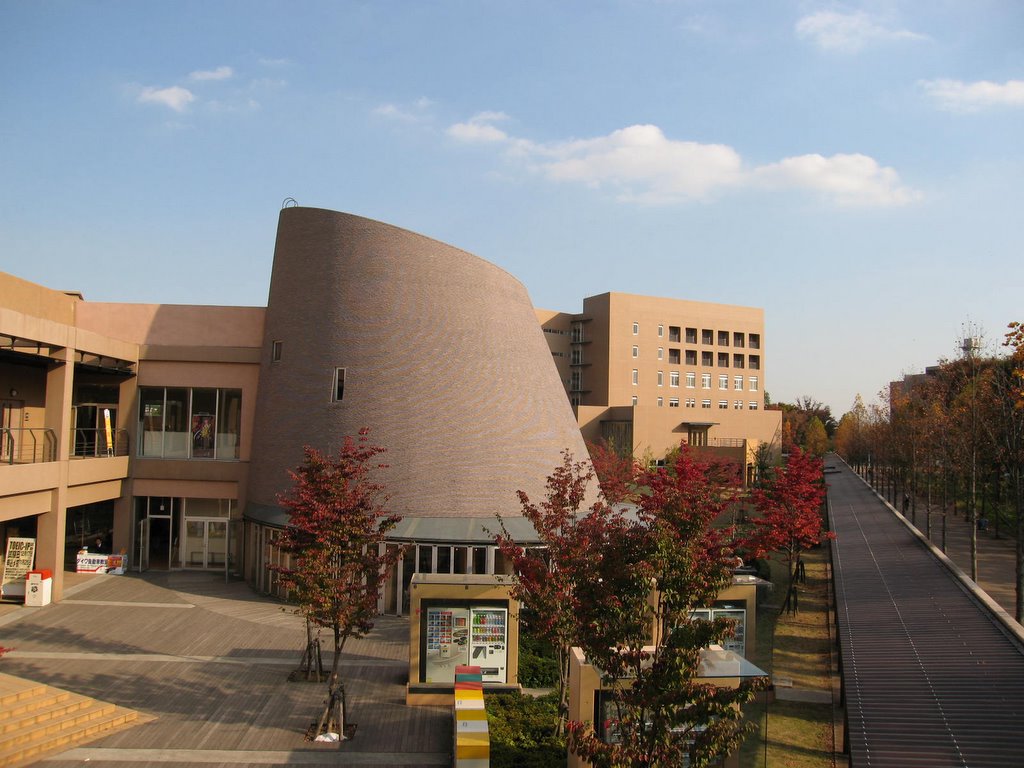
Lecture building:
Student Building, bascially consists of cafeteria, top floor, western food, bottom floor Japanese food. All run by the "Co-Op", there are no outside brand foods in university such as Starbucks for example. Only one store, the "Co-Op" store. Its about the size of a large convinience store, it functions as the schools "bookstore". This is a really small school.

Lecture building:
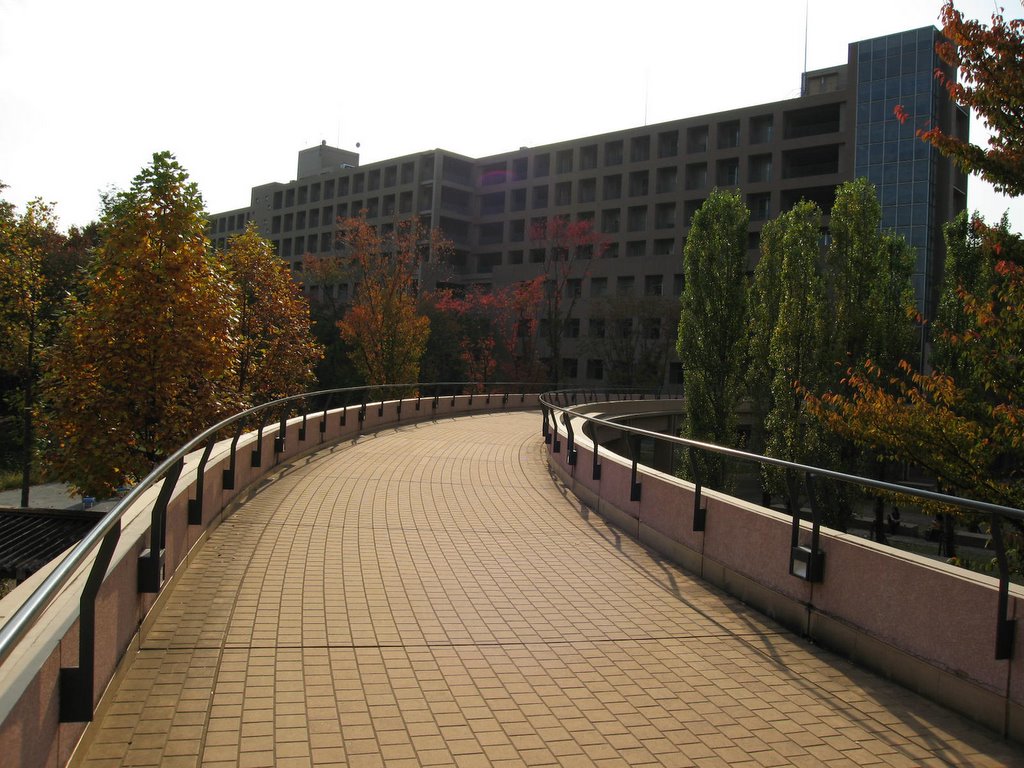
Student Building, bascially consists of cafeteria, top floor, western food, bottom floor Japanese food. All run by the "Co-Op", there are no outside brand foods in university such as Starbucks for example. Only one store, the "Co-Op" store. Its about the size of a large convinience store, it functions as the schools "bookstore". This is a really small school.
Things I Learned from Japanese Business Culture Class
Today was a really interesting class. Our teacher talked about the Japanese employment system and how it works, Basically today, students start job hunting in their 3rd year of university and aren’t expected to have any experience. He said that Japan when compared to other countries may be the easiest place to find an entry level job when graduating from college. He said that before it was even easier, that companies come recruiting students for jobs and now it is a little harder because students have to visit companies. Also he said in the past and still now for some companies, graduating from a prestigious university such as University of Tokyo or Keio University and being an average student is better than being a hard working and good student from lesser schools when finding a job. This is because companies still think that if you pass the high school exam and get into a good university, this student will have better potential in the future to be a loyal and good worker while the student who did not get into the good school has lesser potential in the future. Also here, university is seen as a time of relaxing and socializing compared to the hard times of high school.
Also for humanities and social science graduates, he said it doesn’t matter what degree you get because when you get hired they will train you and keep rotating you around the company so that you get a better feel of the workings of the company. For example, once you have learned the accounting department, you may be rotated to the finance department where you would have to learn all new things again. Before and still now, this way of training employees creates a “company man”, like a “Sony man” or “Toyota man”, someone who has no specialties but knows the company which hired and train them very well. The downside of this is if they get laid off at middle age, they have not much skills to market themselves because they only know that one company and know it very well. Also in Japan, when people talk about what they’re job is, they usually don’t say their position first, but rather say which company they work for first.
Another interesting point that was mentioned in class was promotions. In a typical Japanese company, one may get their first promotion 7 years after first getting hired in the company. Also when you get hired by the company, no matter what your degree is, you may be sent to the company’s shops to work in the front lines there. For example if you were hired by McDonalds and have a business degree, you might spend a couple of months working at the actual “restaurant” with the other part time and contract employees before you get rotated to a desk job. This is because companies in Japan like their employees to get a feel of how the entire company operates. My teacher said during the months starting from April, it isn’t unusual to see maybe people with Masters degrees working at McDonalds.
For students in the hard sciences and engineering, the process of getting hired is a little different. In Japan, many laboratories and departments have close ties to industry, so once you graduate, your professors may recommend you to jobs, so in other words, it seems that you don’t really have to look for work, because the companies can just recruit you easily from connections with the teaching staff.
Also for humanities and social science graduates, he said it doesn’t matter what degree you get because when you get hired they will train you and keep rotating you around the company so that you get a better feel of the workings of the company. For example, once you have learned the accounting department, you may be rotated to the finance department where you would have to learn all new things again. Before and still now, this way of training employees creates a “company man”, like a “Sony man” or “Toyota man”, someone who has no specialties but knows the company which hired and train them very well. The downside of this is if they get laid off at middle age, they have not much skills to market themselves because they only know that one company and know it very well. Also in Japan, when people talk about what they’re job is, they usually don’t say their position first, but rather say which company they work for first.
Another interesting point that was mentioned in class was promotions. In a typical Japanese company, one may get their first promotion 7 years after first getting hired in the company. Also when you get hired by the company, no matter what your degree is, you may be sent to the company’s shops to work in the front lines there. For example if you were hired by McDonalds and have a business degree, you might spend a couple of months working at the actual “restaurant” with the other part time and contract employees before you get rotated to a desk job. This is because companies in Japan like their employees to get a feel of how the entire company operates. My teacher said during the months starting from April, it isn’t unusual to see maybe people with Masters degrees working at McDonalds.
For students in the hard sciences and engineering, the process of getting hired is a little different. In Japan, many laboratories and departments have close ties to industry, so once you graduate, your professors may recommend you to jobs, so in other words, it seems that you don’t really have to look for work, because the companies can just recruit you easily from connections with the teaching staff.


